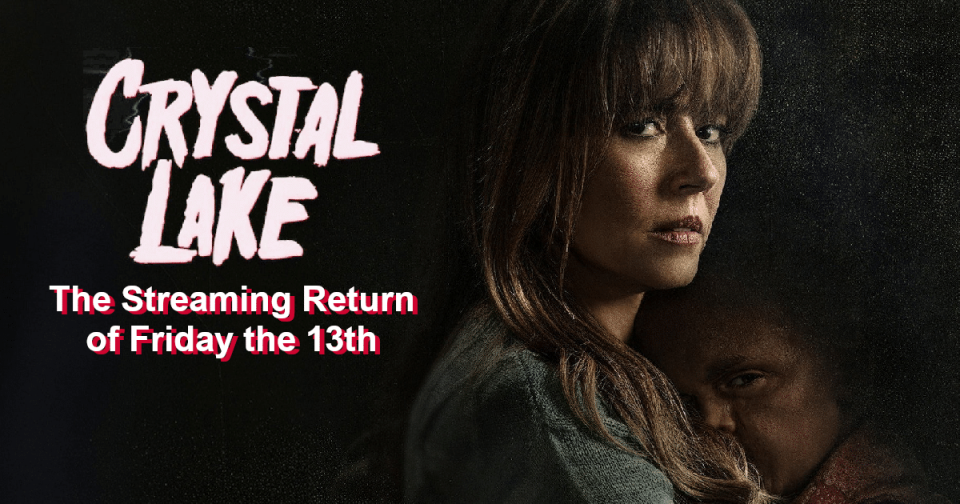

I don’t wanna scare anyone, but I’m going to give it to you straight about Crystal Lake.
A24 has resurrected the Friday the 13th franchise from years of development hell, and it didn’t take a bolt of lightning, a telekinetic teenager, or Freddy Krueger. No, this new beginning comes courtesy of a shift in format. After twelve films, a video game, and an Angry Orchard sponsored short film, Friday the 13th is on the small screen.

Going Back to Move Forward
While the franchise evolves, the timeline is going backward. That’s right, campers. Jason lives and he’s younger than ever. But for the first time since it all started, he’s not the focus.
Now I won’t spoil the show, but if you haven’t seen the first film (or the opening scene of Scream, for that matter), turn back now. Jason’s mother Pamela Voorhees, originally played by Betsy Palmer, is the original killer of the series. Now, it’s Linda Cardellini donning the blue sweater, and these eight episodes cover the aftermath of the franchise’s inciting incident: the drowning of her son.
Prequel Title
By their nature, horror prequels shouldn’t work. I subscribe to the idea that the less we know the better when it comes to these monsters. However, there are plenty of contemporary examples to the contrary; I consider Annabelle: Creation, Pearl, and The First Omen to be among the best in their respective series, so I was ready to build my hopes up yet again and leave my horror loving heart vulnerable for disappointment.
My bar for a prequel to justify itself is simple: I ask myself, “Do I prefer this reality over what I picture in my head?” In the case of Crystal Lake, the answer is yes.

There aren’t many questions left unanswered after the first one, or at least not ones you’re compelled to ask. As with many slasher motives, Pamela’s reasons to kill are delusional, but clear. Her son drowned years ago as the result of counselor negligence, and the idea that Camp Crystal Lake could ever reopen after such a tragedy is blasphemy. Crystal Lake recontextualizes the tragedy by building out the world around it and most importantly, the mother at the center of it.
And sure, it sprinkles in a few extra dead bodies for good measure.
Pamela Voorhees, Aggreived Mother
Palmer’s iteration of Mrs. Voorhees was deceptively kind, and all the more unnerving for it. The way she comforts final girl Alice feels like it comes from a real place, even if she knows she’s going to try to murder her shortly. Pamela in this show has plenty of runway to put that kindness on display, endearing us to her right away. We get a first hand look at what she’ll lose by the time the first movie rolls around, not only with her son, but within herself.
The spectrum of experience Pamela endures here, good and bad, transforms the character from a bit of genre trivia to fleshed out human being. Amidst all of the absurdities of the story, the grief and guilt she carries for her lost son is the real emotional hook that grounds the story. The show has a sense of humor, but the direction wisely keeps the tone around both Jason’s pain and Pamela’s healing (or lack thereof) earnest.
If anything, I wish there was an even tighter focus on this aspect. Despite being gone for less than a year, the memory of her son has already been co-opted into a scary campfire story to the children at Crystal Lake. Pamela has to reckon with that, but I couldn’t help but feel there was meat left on that particular bone.

Linda Cardellini and a Strong Supporting Cast
Linda Cardellini is unsurprisingly the MVP of the season, but the show wouldn’t work as well if William Catlett as Police Chief Levon Brooks wasn’t such a likable co-lead. Both charming and authoritative, the show is at its best when he and Pamela share the screen. One might assume the conspiracy thriller plot thread that he pulls would be jarringly out of place for a Friday the 13th story, but in a series that eventually goes to space, it behooves one to have an “up for anything” attitude.
The surrounding cast is chock-full of returning characters to go along with the new blood. Enos the truck driver and Officer Dorf have one scene apiece in the original film. Here they’re given substantial screen time, and in the latter’s case some real significance to the story. Crazy Ralph, a sorta creepy, sorta goofy harbinger of doom in the first two movies, is made more sympathetic as a veteran suffering from PTSD who is already the joke of the town he fought to protect. Perhaps most clever of all is how the series weaves in counselors Barry and Claudette, the franchise’s first two victims.

Agonizing Pacing
The weakest aspect of the show lies in its overall pacing. There’s good ingredients being thrown into the mix early, but it doesn’t feel like they’re all cooking together until the midpoint of the season. The latter four episodes are the superior half, and the reveals therein – as ridiculous as they may read on paper – fit snugly into the overall lore of the franchise.
That’s not to say it’s without discrepancy. The show seems to operate in a sort of half-canon capacity. It takes place in 1971 while in the timeline of the first film would put Jason’s death in 1957. This loose approach allows the writing team to play into the mythology without being directly beholden to it. This universe is a sandbox and the creative team here is treating it as such, building blood-soaked sandcastles.
A Friday the 13th Joint by Any Measure
Crystal Lake swerves when it should, but this is still decidedly a Friday the 13th story. Anyone worried about them keeping the violence up for nearly 400 minutes can rest easy; the kills are consistent and executed with impressive practical effects.
The decision to film on location in the original New Jersey town buys significant goodwill, establishing the small town and camp atmospheres that are so essential to the franchise’s strongest installments.
The opening credits sequence scored by Harry Manfredini is the perfect invitation back to Camp Crystal Lake at the start of every episode. Homages are there as they are in most IP-based content, but the quality of the show isn’t dependent upon them.
Crystal Lake isn’t here to just revel in the ghosts of Friday’s past. It’s here to make new ones.

Where Crystal Lake Excels
A movie should never feel like it could’ve never worked as a show and a show should never feel like it would’ve worked as a movie. The appeal of Crystal Lake is in its expansiveness within the town. It’s the experience of witnessing the legend crawl its way out of the lake and into the minds of the local adults and superstitions of the camp-based kids.
It reframes the existing movies, but doesn’t erase them. As it stands, their events could still be inferred with only minor realignment. Or perhaps this may be the start of a new timeline. The success of this outing reaffirms that there can still be stories to tell in these classic properties if the creatives behind them think outside the box.
Whether it be with Pamela or Jason in a movie or show, I doubt this will be the final Friday.