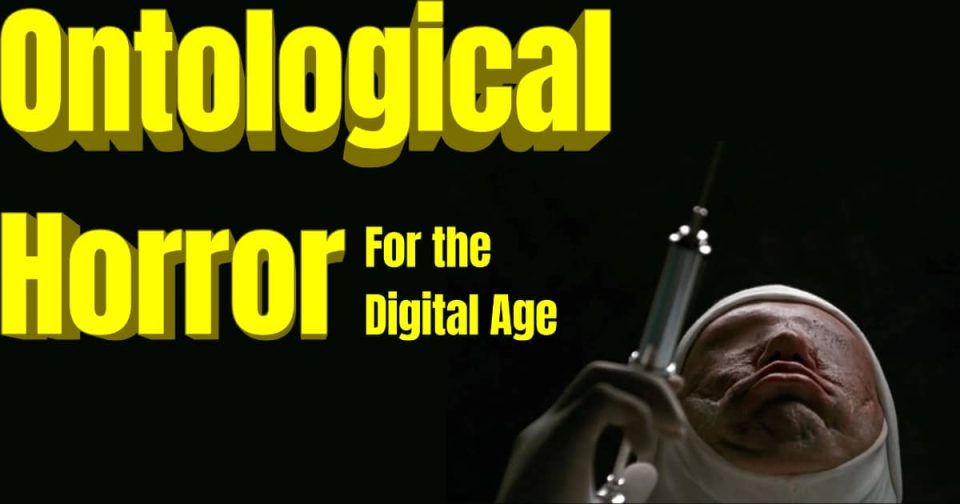

Very recently, an astute gentleman approached me and said, “Since most of your brain cells have regenerated from the trauma induced by your foray into the corporate world, why not get back on the writing horse, grab your literary jousting sticky thing (I’m still rebuilding my vocabulary) and generate an article about Ontological Horror and the dread of broken reality in the digital age for Malevolent Dark?”
Because I have desperately missed writing anything about anything, and am addicted to literary research in the pursuit of new authors, creators, and genres, I hollered out “Giddy-up!” jumped upon my charger (or a Newfoundland dog named Henrietta) and galumphed down to my basement office to blow the dust off my laptop. There was a lot of dust on my laptop—it was three days later when I stopped sneezing and yoinking spider corpses from my nose holes (sorry, I meant nostrils).

Cosmic Absurdism and Ontological Horror
In the past, I have written articles on Absurdism and the successful reclamation of Cosmic Horror from its initial racist roots by African American writers for Malevolent Dark. If you haven’t already read them, please check them out. Based on that research, I figured undertaking the explanation of Ontological Horror using modern literature and cinema shouldn’t require too much heavy lifting for my healing psyche. Because Ontological Horror is the natural progression of the existential dread originated by Lovecraft’s Cthulhu mythos and perpetuated by the stories and novels created by authors such as Brian Evenson, Thomas Ligotti, and Michael Cisco.
Their absurdist, Lovecraftian styles force readers to question humanity’s role in the universe and its perceived dominance of the food chain on Earth. Ontological Horror then applies the emergent ideas surrounding evolving technology’s effects on culture, religion, and science in a society already doubting its validity. Is the universe real or has it been fabricated by higher intelligence? Is humanity little more than a fanciful whim of some version of an Artificial Intelligence? Are humans merely pawns in a game they actually believed to have created?

What is Reality?
Ontological Horror focuses on the dread generated by digital-age concerns over the tangibility of our reality, despite a lifelong reliance on its presence and parameters. As a result of this tech-driven uncertainty, ontological horror does not rely on blood, gore, jump scares, or monsters in order to be terrifying.
Its ability to frighten stems from the idea that the stable constructs our rational society depends on for interpreting life on Earth and the surrounding universe is false, imagined, manufactured, or delivered by an unreliable narrator. The bleak plots and dark themes of ontological horror fracture the inherent expectations defining modern human existence by generating doubt concerning the potential artificiality of our existence, our sense of self, and the actual condition of our environment.
In Other Words
In other words, our history ain’t our history. It’s just a small chapter written into the personal diary of an interplanetary pirate named “X-4-backflip-Joey-12” as it records embellished adventures to q-mail home to the most significant of all its mates “P-9-circleturkey-Stusanna-87” in hopes of receiving future magical tentacular attentions. Ontological Horror flips and twists the real world to say, that dog ain’t no dog. Petting that dog will get you a fistful of emu feathers, which if you swallow will allow you to sprout gills, just like everyone else. So you can swim underwater all the way to New Zealand, which exists, as it always has, fathoms beneath the Australian continent.
Yes, Mr. Anderson, praise the god Q-Bert for a safe trip out of the Etherscape and bless the AI implant which allows you access to the 7th portal of the Minecraft 3.4 prototype developed by SkyNet, leading into the digital circulatory system of the mind hive collective funded by NASCAR/NASA command.
Yep, just like every bit of content A24 produces after snorting a cocktail of GLP-1, HGH, Meth, and sour gummy worms. Legitimate existential dread that can only occur when fingers hover over keyboards, VR goggles get strapped on, and new generations of phones evolve into devices completely unphone-like (I knew trouble was afoot when phones began looking more like toaster strudels and less like bananas).

So That’s What Reality Is… Can We Trust It?
Ontological Horror offers themes that question our reliance on this version of reality versus our doubts concerning this version of our reality. It explores the potential instability of our perceived existence, it teases its audiences with characters whose thoughts and memories might be genuine or completely artificial. Identity erodes to meaninglessness as the rules of existence waver, and audiences question their fundamental belief systems. All of this amidst subtle atmospheric builds to promote a stifling dread we aren’t even sure we should be feeling, let alone succumbing to.
Ontological Horror blurs the lines between what might be the impending insanity of an unreliable narrator or an actual approaching dystopia. Settings and environments defying the laws of science are populated by an eclectic cast of eccentric characters where monsters are not a prerequisite for generating fear. Not when the antagonist could feasibly be the universe, an abstract theoretical concept, or an inescapable looping paradox. All of these obscure options culminating in an ambiguously bleak resolution.
A huge menu of literary themes and characteristics to draw from akin to those listed upon the infamous whiteboard displayed behind those fictional corporate stooges responsible for the death scenes seen in The Cabin in the Woods or promised by those rooms nestled within the inter-dimensional sprawl of never-ending greige office spaces in Backrooms. Let’s take a deeper dive into some of the stories and films that best exemplify this horror sub-genre.

Key Contributions to the Genre
Since Ontological Horror’s key themes of the instability of reality, the fabricated or simulated self, isolationism, and the erosion of personal identity can be viewed as the natural evolution of Cosmic Horror and Absurdism once advanced technology has been applied, many authors previously discussed in my past pieces can be referenced to exemplify ontological characteristics in literature.
I will look at these writers briefly, offering new reading choices by them in the effort to avoid being repetitious. Some well-known names, long associated with the Cthulhu Mythos and who can be included in the ontological sub-genre as well, are: Brian Evenson, Michael Cisco, Thomas Ligotti, Laird Barron, and John Langan. Specific ontological titles by Evenson in addition to those I have recommended in the past (“Looking Out,” “Song for the Unraveling,” “Room Tone,” and “The Hole”) are “Smear” and “The Glistening World.” Ontological short stories by Cisco beyond those I have mentioned previously (“Intentionally Left Blank,” and “Saccade”) are “Antisocieties” and “Water Machine.”
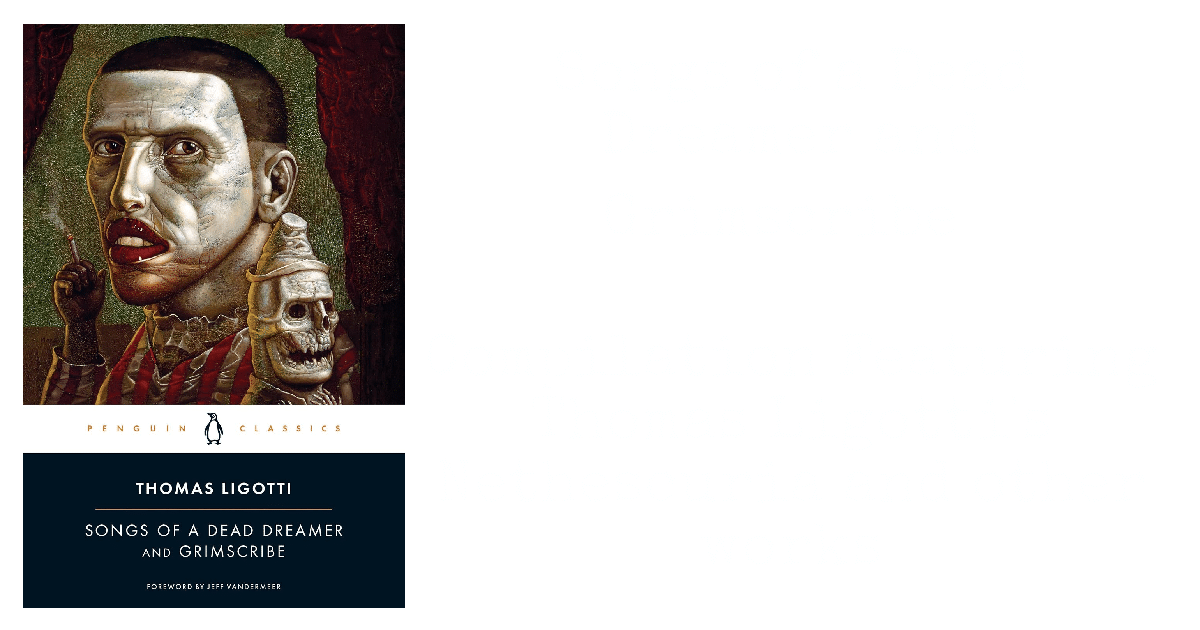
Thomas Ligotti
Thomas Ligotti’s stories, “The Red Tower,” “Bungalow House,” and “Nethescuria” offer ontological themes demonstrating how human self-awareness is an evolutionary mistake causing humanity to recognize the nightmare of its true existence. They also provide readers with a narrator experiencing a dissolution of the boundaries dividing alternate worlds, revealing hidden realities that were once unknown. Ligotti forces readers to recognize the possibility of their own insubstantial selves as his characters suffer the same existential dread from bombardment by parallel existences, perhaps more real and autonomous than the character’s understanding of reality, and the creatures residing there.
John Langan
Many of John Langan’s stories have used the ontological theme of grief and suffering to open gateways to parallel universes. The sorrow sustained by his characters proves to be powerful enough to open portals to alternate realities. His fictional environments are stacked to allow humanity to exist on its own plane, completely ignorant of the other layers surrounding it until those veils are made transparent.
“The Shallows” and “Children of the Fang” force characters, and thus the readers experiencing the story through them, to question the sanity of a reality assumed to be reliably explored and proven “real.” There’s that existential dread again. Resulting when our fundamental truths are brought into question; or, worse yet, straight up proven an illusion.
Laird Barron
Laird Barron’s ontological short stories, “Occultation,” “Nemesis,” and “Procession of the Black Sloth,” touch upon the theme of manipulation where humans are little more than puppets being toyed with for the greater good of larger, typically unseen forces existing on another plane or in an alternate reality. They explore the concept that humanity’s version of the world and the surrounding universe is a fragile and malleable one, where human kind is kept servile and ignorant.

Until modern technology or chemistry shreds that veil to reveal these truths to a character who is either too frail, damaged, or unenlightened to conceive and accept these experiences as true and report them for the future good of humanity. Barron uses the ontological sub-genre of horror to investigate the concept of mutability. The idea that man can be physically and/or metaphysically altered in place of death to fit into a monstrous, sometimes digitized, collective (possibly tended to by a coffee clatch of naked old women residing in an apartment complex in China).
Ken Liu
Another application of this mutability theme by an author not mentioned yet is, “Staying Behind” by Ken Liu. In it, humans choose to die physically so their minds can be uploaded into the Machine to remain sentient for eternity. People abandon their physical forms in droves to escape war, hardship, and poverty. It is a new version of evolution, though many question if this is how humans were intended to exist. Parents fight to prevent their children from uploading, but the Machine sends out propaganda to lure them in. Perhaps the parents are in the wrong though, and their viewpoints on reality are flawed as their children sneak out to get uploaded without parental consent.
Liu has also written “The Perfect Match” which looks at the intrusive nature of AI and how humans have become reliant on its intrusiveness. The proponents of further AI interference and intervention are so convincing in their arguments for further advancement in the field that it becomes confusing as to whose opinions are beneficial to humanity and whose are detrimental; AI tech and those supporting it or the humans trying to sabotage its reach and destroy its progress.
Another interesting ontological piece by Liu is “Simulacrum.” In it, Paul Larimore has developed a machine that converts reminiscences, pictures and videos into holographic images that correctly interact with those who initially experienced them. They are synergistic digital snapshot moments that react and respond accordingly. By skewing historical events and allowing its viewers to relive history differently at different moments, this story demonstrates the ontological themes of the instability of reality, the erosion of human identity, and the artificiality of human life. As can be expected from ontological pieces, “Simulacrum’s” narrators prove unreliable in relating their versions of reality.
Ted Chaing
Ted Chaing’s “Exhalation” is also a very cool example of how an ontological piece can be horrifying without using monsters, jump scares, blood, gore, or torture. Chiang generates fear and dread by demonstrating the frailties of society. In this short story, humans have already been replaced by robots, but these robots are far from mechanically perfect; they suffer from memory loss. They also carelessly ruin their environment in the name of technological advancement. Chiang’s story demonstrates a bleak resolution by delivering a message that conveys the frailty of all life, whether human or not.

Readers expect robots to thrive because they are computer-driven mechanisms, but “Exhalation” demonstrates how all civilizations can be unreliable and unstable. Infinite fabricated selves are at as much risk for extinction as our organic selves when environmental concerns are ignored or taken for granted. Technology can ruin individuals and their societies even if those individuals are technological advancements themselves. Nothing is safe and sacred from the existential dread generated through ontological horror.
A Veritable Potpourri of Skewed Realities
If you enjoy Ken Liu and Ted Chiang, try Kathe Koja, Hailey Piper, and Jeff Vander Meer next to help solidify all your conspiracy theories surrounding modern tech, alternate realities and the evil of AI.
If you prefer experiencing your existential dread through watching it rather than reading it, some great movie examples of the ontological sub-genre are: Backrooms; Good Luck, Have Fun, Don’t Die; Inception; The Matrix, Into the Mouth of Madness; Everything, Everywhere, All at Once; The Butterfly Effect; Jacob’s Ladder (the 1990 Tim Robbin’s version, not that turd of a remake from 2019); Exit 8 (there are subtitles associated with this Japanese release based on a video game, you will have to put down your toaster strudel while viewing) and 12 Monkeys.
Back to Reality, I Think
Enjoy. Have fun. Don’t hate me. Actually, go ahead and hate me. Because who knows which version of me you would be hating. The flesh and blood version generating this content? Or perhaps there is another DuBois, a mechanized version blipping in and out of this reality from a parallel dimension? Pulling the strings of your entertainment needs and directing you to this article on this webpage, despite your assurances of independent thought and natural preferences developed via individuality and free will.
A digitized alternate-version DuBois might have code-written for you and uploaded into your head while you dreamt of werewolf romance plots and recipes for unicorn stew. So, go ahead and hate the video-me(?), it could all be a part of my master plan for manipulation and self-doubt. Or not….