

For those who didn’t grow up in the 1970s and 1980s, you will never understand the significance of things like Godzilla Week.
For many who grew up in Michigan during the 1970s and 1980s, Godzilla Week on the NBC affiliate in my hometown is a major core memory. I am one of those people. This was a time when over-the-air antennas reigned supreme. Listening to the radio was still a viable way to get information, and it was the time before cable television became commonplace and well before the explosion of streaming services.
Just writing that makes me feel old and helps me understand why my teen and other members of Gen Z will reference the 20th century as the “1900s.” This was also a time when local stations relied heavily on syndicated movie packages to fill their late-afternoon time slots. WNEM hosted theme weeks. Other stations did as well. Undoubtedly, there were horror-themed versions and some that ran on Saturday afternoons. To this early-elementary-school-aged child, nothing, and I mean nothing, was better than Godzilla Week.
This was must-see television before “Must See TV” became a tagline for NBC in the 1990s.
Sprinting Home For Godzilla Week
I can still remember getting off the bus, running home, flinging the door open, tossing my “The Empire Strikes Back” lunch box, not the plastic one, but the metal one with Han, Chewie, Princess Leia and C-3PO in the cockpit of the Millennium Falcon gracing the front, onto the kitchen counter and running to turn on the television. I was definitely a Han Solo kind of guy.
I was then, and I am now. Anyone who doesn’t know that Han shot first is the epitome of a stuck-up, half-witted, scruffy-looking nerf-herder. This wasn’t some fancy 4K flat screen. This was a giant, wooden, three-ton monstrosity of a cathode-ray-tube color television. At best, it was 27 inches, but it felt huge.
During Godzilla Week, the movies usually aired at 4 p.m., right after kids got home from school but before the evening local news. During that beloved week, WNEM dedicated a full Monday-through-Friday block to the King of the Monsters, broadcasting a different classic Showa-era Godzilla movie each day. While I enjoy other eras of Godzilla, the Showa era was, and is, my favorite. Dare I say it, it’s the only one that really matters to me.
Needless to say, this annual week created a core memory for Michigan monster kids like me who would rush home to adjust their television’s rabbit-ear antennas, or, in our case, the rotary antenna tower my dad had installed outside our house, to watch Godzilla battle King Ghidorah, Mothra, the Smog Monster/Hedorah, Megalon or Mechagodzilla.
What a time to be alive. There was no DVR or VCR in my house. There was no streaming. There was no YouTube. If you missed the movie, you missed the movie. There wasn’t an app where you could search “Godzilla vs. Megalon” and have it playing 14 seconds later while simultaneously scrolling through your favorite social media platform or horror-themed website. If you wanted to watch Godzilla, you had to be home when Godzilla was on. And if you weren’t? Well, tough luck, kid.
As for the movie I most wanted to watch during this week, that’s easy: “Godzilla vs. Megalon” (1973). While the 1954 original is a monumental film that deserves all the credit for bringing the world one of the greatest movie monsters of all time, as a kid, I wasn’t down for the dark tone the original brought. I was looking for the goofy, tough, good-guy Godzilla. Nothing achieves that, or reaches S-tier status, quicker for me than “Godzilla vs. Megalon.”
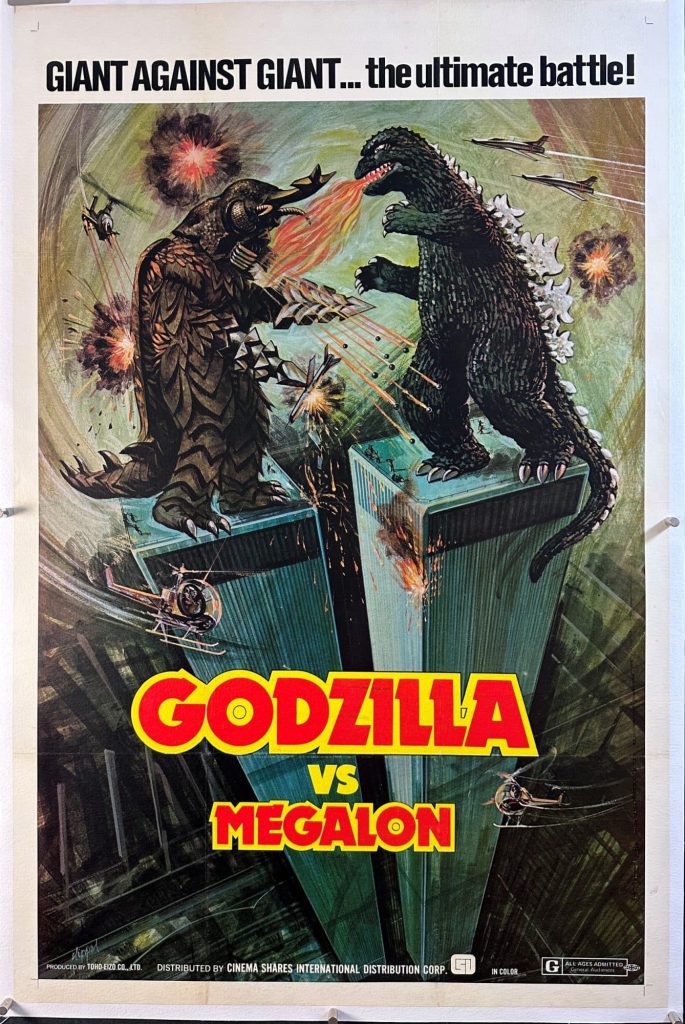
Godzilla vs. Megalon
Want goofy? This movie has it in spades. Granted, I think the dubbing is partly to blame, as the dialogue probably didn’t translate particularly well, but the whole thing is absolutely absurd if you think about it. The premise is simple enough. An undersea civilization called Seatopia unleashes a giant cockroach/beetle monster named Megalon to destroy the surface world in revenge for nuclear weapons testing.
Megalon, along with another kaiju baddie, Gigan, teams up to take on the King. But Godzilla has backup, too: a robot named Jet Jaguar. Think Ultraman, but not an alien. Jet Jaguar is a robot who decides to grow to the size of a kaiju to help protect the human race. Truth be told, he gets his ass handed to him until Godzilla arrives from Monster Island to save the day. Yes, it is as bizarre as it sounds, and I am all for it.
The explanation Jet Jaguar’s creator, Goro Ibuki, played by Katsuhiko Sasaki, gives for how his robot was able to grow to kaiju size and fight is pure insanity. After the robot returns to normal size, Goro explains that Jet Jaguar returned to normal and back under his control because he decided his job was done.
At the same time, and I quote, “But still, I reckon he’d do it again, if the need ever rose again.” But his compadre and race car driver, Hiroshi Jinkawa, played by Yutaka Hayashi, just accepts it like Goro had told him the sky was blue. No questions. No hesitation. “Well, let’s just hope that it doesn’t. We’ll warn the scientists to be more careful in the future, and let Seatopia rest in peace.” Sure. Sounds reasonable.
Nothing to see here.
Jet Jaguar was AI before AI. Let’s just hope the real AI is more like Jet Jaguar and not Skynet.

Goro’s son or younger brother, Rokuro, is also quite possibly the most annoying kid on celluloid. No lie. I did want his floating dolphin, though. Think of a pedal boat, but instead of the body of a boat, you are riding atop a floating dolphin-shaped contraption. The kid was riding this dolphin thingy before the lake he was using it in drained. I had never seen anything like it before or since. Apparently, this was perfectly normal behavior in the Showa era of Godzilla movies. Need a ride? Hop on the dolphin.
Need a giant robot? Build one. Need your robot to become 50 feet tall? Apparently, that can be arranged, too.
Monster Mixed Martial Arts
This is also the movie where Godzilla performs his infamous dropkick. And yes, I said dropkick. While the movie came out in the early 1970s, I watched it during the 1980s and the heyday of the WWF. It makes sense as it’s like a tag team match between Godzilla and Jet Jaguar and Megalon and Gigan. So naturally, seeing the King of the Monsters launch himself feet-first through the air like some kind of giant, radioactive professional wrestler was awesome. It is utterly ridiculous. It is also one of the greatest things ever committed to film. I will die on that hill.
The movie was shot in just three weeks on a tiny budget, and somehow that makes me love it even more. There is an undeniable charm to these movies. The costumes, miniature sets, dubbing, special effects and fight choreography all have a certain homemade quality that modern blockbusters simply can’t replicate and that is exactly why I love them.
Today, we have movies with computer-generated monsters so realistic that you can practically see every scale, muscle and facial expression. When done right, these are great, but back then, you had a guy in a rubber suit stomping around a miniature city while another guy in a rubber suit waited for his turn. And somehow, my younger self bought every second of it.
Actually, I still do. That’s the magic of Godzilla. For me, it isn’t just about the monster. It’s about the memories. It’s about sitting in front of that giant television after school. It’s about the sound of the television coming on. It’s about the anticipation of seeing which monster Godzilla would be fighting that day. It’s about being a kid in a time when entertainment wasn’t available whenever you wanted it. You had to wait. And sometimes, waiting made it better.
Godzilla Week was an event. It was appointment television before I knew what appointment television was. It was something you talked about at school. It was something you looked forward to. It was something that could make an otherwise ordinary week feel special. And somewhere along the way, those movies became much more than old Japanese monster movies being broadcast on a local television station. They became part of who I am. I still love Godzilla. I still prefer the Showa-era movies.
I still think “Godzilla vs. Megalon” is one of the most wonderfully ridiculous movies ever made. And I still have a soft spot for Jet Jaguar, even though his entire existence raises approximately 4,000 questions nobody involved with the movie seemed particularly interested in answering. Most importantly, I have my hometown television station to thank for making me a lifelong Godzilla fan.
Godzilla Week introduced me to the King of the Monsters at exactly the right time in my life. I was a kid. I loved monsters. I loved science fiction. I loved Star Wars. I loved anything that involved things blowing up, giant creatures smashing buildings and the possibility that a giant radioactive lizard might show up and ruin everyone’s afternoon. In other words, I was the target demographic.
If “Godzilla vs. Megalon” wasn’t part of Godzilla Week, I was mad. Really mad. Godzilla Week was serious business. And decades later, I still remember it. That, more than anything, is what makes those old movies special. They aren’t just movies anymore. They are time machines.They take me back to a house in Michigan, a giant wooden television, a metal Star Wars lunch box sitting on the kitchen counter and a kid who had just gotten home from school and had absolutely no intention of missing Godzilla.
Not for anything.
What a time to be alive.